
WAYS TO WORK TOGETHER
A whole-person approach to feeling better, moving with confidence, and staying available for whatever calls you.
For people who want to understand their bodies well enough to keep moving, creating, traveling, working, and participating fully in the lives they’ve built.
SOUND FAMILIAR?
You’re doing everything that’s supposed to help. Why does it still hurt?
You’ve followed the prescribed exercises and even found stretches that bring some relief, but you’re not sure what to do when the pain comes back… or has suddenly moved from your arm to your back?
It’s frustrating, right? And you’re starting to wonder whether staying mobile as you age will always mean chasing one problem after another.
WHAT’S POSSIBLE
Your body can adapt, recover, and reorganize itself.
Picture yourself ten years from now: you still have choices about where you live, how you spend your days, and how much help you need. You have the strength and mobility to make exciting plans with people you love — and not be the person everyone else is making plans around.
That’s what you’re building now: a future that still belongs to you.
WAYS WE CAN WORK TOGETHER
You have so much life left to move through. Here’s how we support the body that will get you there.
Massage for Rest + Recovery
For when nothing is “wrong,” but your whole system could use some care.
Choose a 30-, 60-, or 90-minute massage focused on relaxation, recovery, and helping your body let go of what it’s been carrying.
—
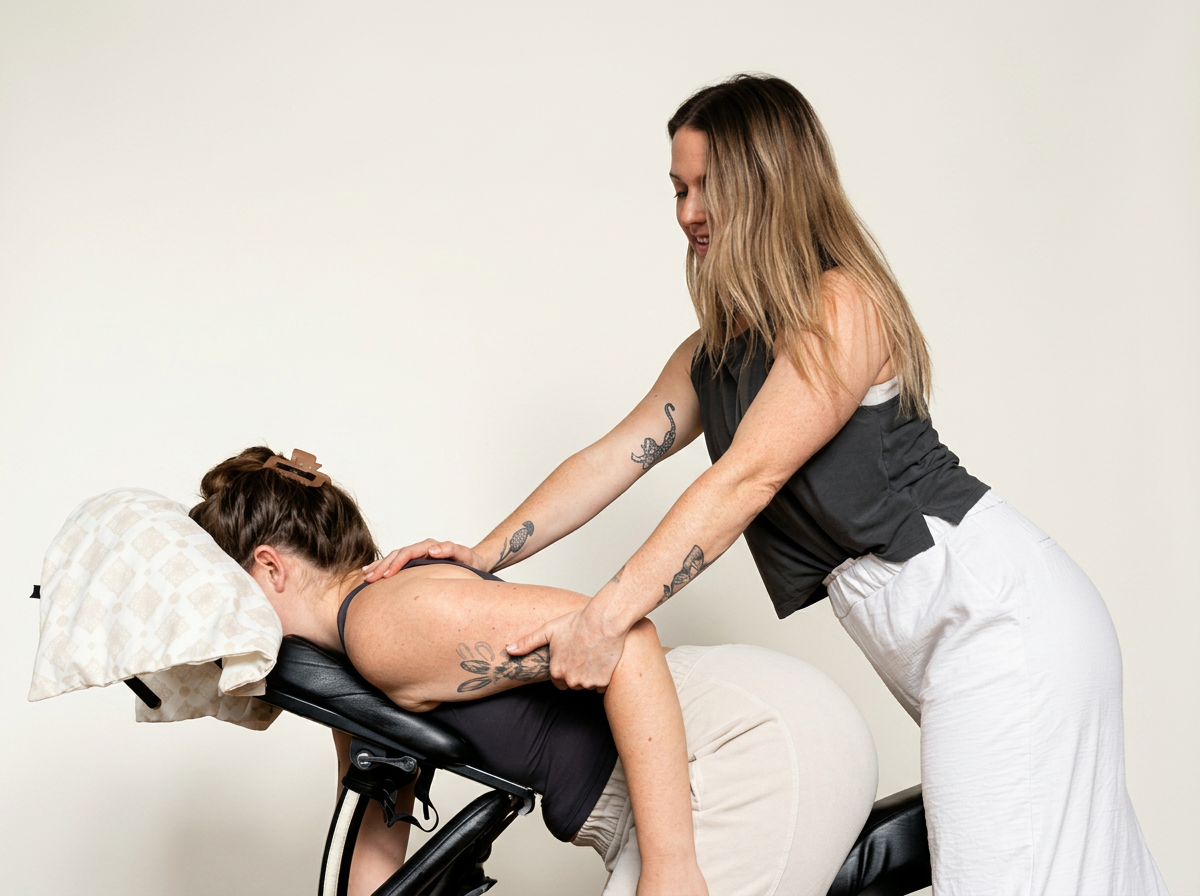
Your session may include myofascial release, deep-tissue massage, assisted stretching, manual lymphatic drainage, acupressure, and heat or cold therapy, depending on what would feel most supportive that day.
Bodywork for Pain + Injury
For recent injury, chronic pain, or a restriction that interferes with your life.
Choose a 30-, 60-, or 90-minute session combining muscular assessment, assisted stretching, massage, and targeted hands-on techniques.
—
We’ll work with the place that hurts while also paying attention to the surrounding patterns that may be keeping the problem going.
Foundational Movement Assessment
For when you want to understand how your body is moving and what to work on.
We’ll establish a baseline movement profile and look at left-to-right symmetry, joint mobility, stability and balance, coordination, pain patterns, etc.
—
You’ll leave with a personalized strategy and clear recommendations for future care. This is the best starting point for personalized movement coaching.
For any of these services, your first step is the same…
PTs and doctors are limited by prescription. I’m not.
We can’t really blame them — that’s their job, after all. But a prescription is a response to one injury, when your body is a whole interconnected system. When your knee hurts, your hip may take on more work. When your shoulder guards, your neck and ribs adapt. Those compensations can become just as important as the place where the pain began.
I studied Kinesiology and Sports Science, trained in massage therapy, and learned at Psoas Massage + Bodywork in San Francisco. Fifteen years of hands-on practice — alongside my training in yoga, dance, and mindful movement — have taught me to notice the asymmetries, habits, and protective patterns that a single diagnosis can miss.
When I look at you, I don’t see an injury. I see a whole, complicated person whose body has been adapting around the problem. Those connections fascinate me! I love following the clues, asking the next question, and helping you understand what your body has been trying to tell us.
BA, Kinesiology & Sports Science · Certified Massage Therapy Practitioner
Yoga Alliance 200-Hour Teacher · 15+ Years in Practice
“
She’s not just the masseuse, per se. She’s like the physical therapist you go to when the doctor sends you to one.
- NORMA M., CLIENT SINCE 2016
FAQ
Some questions you might have:
-
Start with a 30-minute consultation. Tell me what’s happening, what you’ve tried, and what you want your body to help you do. We’ll untangle the central issue and choose the most useful next step together.
-
You don’t need perfect language or a diagnosis. “It hurts when I walk” is enough to start. I’ll ask the next questions — when it begins, what changes it, what you can’t do — and help turn what you’re feeling into useful information.
-
We won’t begin with a generic routine or look only at the place that hurts. I consider your full body, the structures compensating around the problem, your movement patterns, and the demands of your actual life. Then we decide what combination of hands-on care and movement makes sense for you.
-
We won’t force your body through someone else’s routine. We’ll identify what you can do safely, what needs modifying, and how hard you need to work to create change without provoking the problem again.
-
Some techniques can feel intense, but pain isn’t proof that a treatment is working. Your feedback is part of the session. We can change the pressure, position, or approach whenever your body asks us to.
-
Bring that history with you. We’ll account for previous injuries, procedures, restrictions, and current medical care. If your symptoms require testing, diagnosis, or treatment outside my scope, I’ll tell you and help you identify the right kind of provider.
-
No honest practitioner can guarantee how a body will respond. What I can promise is that we’ll establish a baseline, pay attention to measurable changes, and adjust rather than repeating something that isn’t helping. If I don’t believe I’m the right person for the problem, I’ll be honest about that too.
-
It depends on what’s happening and how long your body has been adapting around it. Some people feel meaningful relief quickly; chronic patterns usually need more time and repetition. We’ll discuss the likely progression before asking you to commit to a plan.
-
When they would help, yes, but not a page of exercises you’re unsure you’re doing correctly. I’ll teach you each movement, watch you perform it, and make sure you understand what it should feel like and when to use it.
-
Then we need a plan that fits your real week, not an imaginary one. We’ll focus on the smallest useful practices you can repeat consistently and adjust them when work, travel, family, or a flare-up changes the schedule.
-
Absolutely. Nothing has to be wrong for your body to deserve care. General massage sessions can focus entirely on rest, relaxation, and recovery.
-
Consultations and personalized movement coaching can happen online. You’ll receive the same one-on-one attention while I watch how you move, offer adjustments, and help you build a practice using the space and equipment available to you.
“
"Esther wouldn't just take the 'I'm fine.' She'd ask the next question. She'd say things like, 'Well, how are you doing on the stairs?' — and she knows I have stairs in my house. A general PT person, I don't know if they know that. And when Esther can't identify something, she says so. She's never giving information she isn't comfortable is accurate."
- DENISE D.
You don’t have to know exactly what’s wrong to start feeling better.
Maybe all you know is that the pain keeps returning, a movement no longer feels safe, or you’re simply tired of guessing what your body needs. We can start there.